Sunday, 9 July 2023

Bengal panchayat elections: List of ‘sensitive’ booths not given, says BSF official; Rajiva Sinha denies allegations


Writes : Kinsuk Basu

The BSF coordinator for the deployment of central forces for Saturday’s Bengal panchayat elections never received a list of the sensitive booths from the state election commission despite several reminders, a BSF official has claimed, but the state poll panel chief called this a “wrong allegation”.
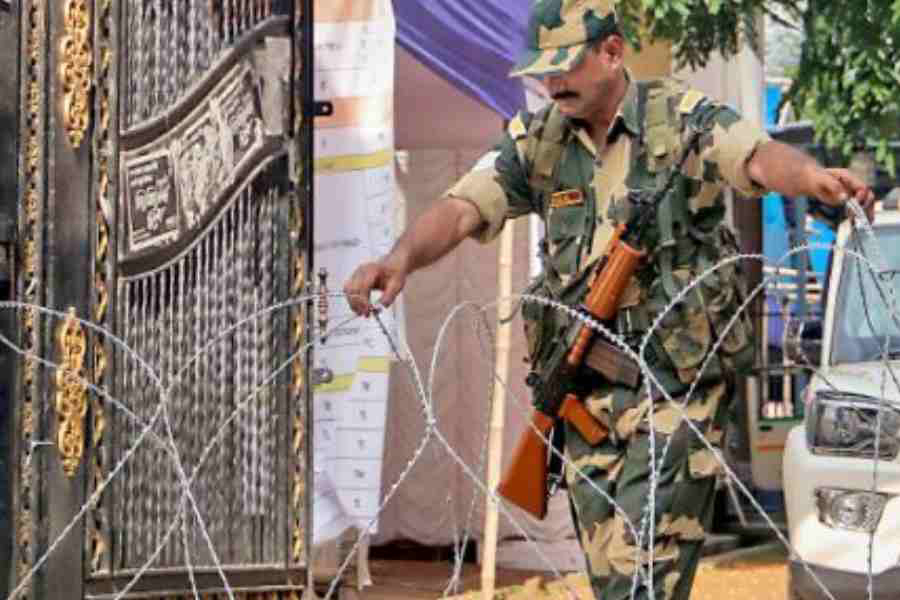


“We have been seeking for (sic) the list of sensitive booths from the state election commission since July 5 through several letters,” BSF deputy inspector-general S.S. Guleria was quoted as saying in an interview with ANI on Sunday. The BSF inspector-general was the coordinator for the central forces.

“We held a few coordination meetings. In a reply to one of our letters, we were informed that out of a total of 61,636 polling booths, 4,834 were sensitive but no details about them were provided,” Guleria said.

State election commission head Rajiva Sinha told The Telegraph: “Wrong allegation. List of sensitive polling stations was provided to them by DM/ SP (district magistrates and superintendents of police) as was decided in the meetings with them.

“The same was done with state armed police (Bengal). We provided the numbers district-wise. It is recorded in our communication with IG BSF also. They confirmed too. If this was not the case, how come they placed their force at every sensitive polling station?”

The central forces had largely been invisible amid the violence on Saturday that claimed 18 lives, a trend highlighted by both the ruling Trinamul Congress and the Opposition parties. Guleria’s comments were clearly aimed at deflecting the blame for the mayhem on the state poll panel and the Bengal administration.

“We were told that district magistrates and police superintendents at the ground level will inform us about the location of these sensitive booths,” he said.

“The monitoring about deployment of forces in sensitive booths that should have happened from the level of the force coordinator did not take place.”

Guleria suggested that had the coordinator been provided with the list of sensitive booths, the central forces could have reached them earlier and carried out proper area domination.

“There was no casualty in places where the central forces remained deployed. In one or two places where hooligans tried to disrupt, the forces handled the situation very professionally,” Guleria said.

“We had to fire two rounds in the air at one place and at another a stun grenade had to be used to disperse the crowd. The BSF captured five persons in a booth when they were trying to capture it and handed them over to the state police.”

A senior IPS officer questioned the state poll panel’s assessment of the number of sensitive polling stations.

About 9.9 percent of the 5,438 booths in Murshidabad were identified as vulnerable (sensitive). The district witnessed five deaths on Saturday.

Of Howrah’s 3,031 polling stations, 353 were marked vulnerable while 317 of Cooch Behar’s 2,385 polling stations were so identified. Both districts witnessed widespread violence and malpractice.

“There was some error in the way booths were assessed for their vulnerabilities. It can’t be based on the records from the previous elections alone,” the IPS officer said, seeking anonymity.

“There are several other considerations, including the location of a booth and the political situation.

“The forces were deployed at the (officially identified) vulnerable booths on Saturday but since there was an error in assessment, the results did not show.”

Sinha, however, told this newspaper: “In any case, with the decision of hon’ble (high) court there was no distinction between sensitive and non-sensitive booths. All booths were to be provided with CAPF (central armed police forces). Later on, hon’ble court talked about feasibility (of such a measure). Still, all sensitive booths were provided with CAPF first.”

The state election commission had demanded 822 companies of central forces from the Union home ministry. By 11am on Saturday, 649 companies had reached the state.

A team of 73 Punjab police personnel had reached Bhangar around 4pm, by when polling across most of the booths in this politically volatile pocket had been over.

State Congress president Adhir Ranjan Chowdhury alleged on Sunday that the Centre had helped the ruling Trinamul by ensuring the central forces were deployed late and left inactive.

“It was part of an understanding between Didi and the Centre — the way the central forces were deployed gave Trinamul an edge in the polls,” Chowdhury said. “Central forces reaching at noon on polling day! The state BJP leaders should rise in protest.”

The state BJP has accused the Bengal government and the state poll panel chief of deliberately keeping the central forces away from the action. Suvendu Adhikari, leader of the Opposition, said the Bengal BJP would make sure that “this is the last election under the leadership of Mamata Banerjee” in Bengal.

Trinamul said the poll violence was the result of provocation by the Opposition and the governor, whom it accused of acting as a BJP spokesperson.

“Some incidents have occurred. There were provocations from different corners by the Opposition and the most respectable governor, who acted as the BJP’s spokesperson, and as a result these incidents took place,” Trinamul leader and minister Chandrima Bhattacharya said. “All deaths are tragic but Trinamul Congress workers and candidates have been victims too.”

Via : The Telegraph

Saturday, 8 July 2023

Death stench over Bengal panchayat polls: 18 killed in clashes, question mark on central forces


Writes : Meghdeep Bhattacharyya

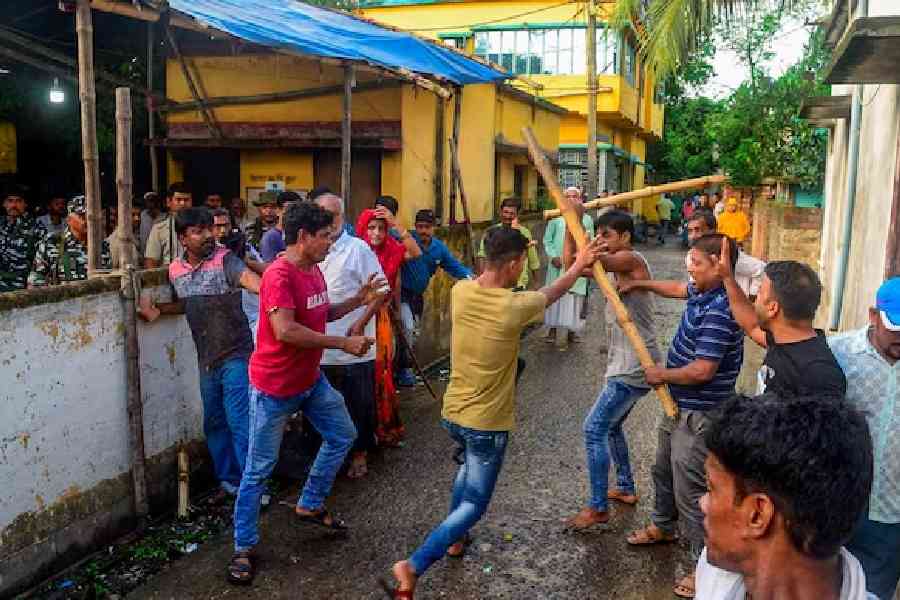
Bengal on Saturday reaffirmed its reputation as the country’s most politically violent state, reporting at least 18 deaths on the day of the panchayat elections after a body count of 22 in the run-up to the vote.

Seventeen of the dead, including seven who died on Saturday, were from the Trinamul Congress, a point the ruling party emphasised as it sought to deflect most of the blame for the bloodshed on the Oppositio

Five years ago, at least 19 people had died on polling day – even with 34 per cent of the seats uncontested – after 14 had been killed during the campaign.

According to figures that chief minister Mamata Banerjee had cited repeatedly during the campaign this time, at least 39 deaths had been witnessed during the 2013 panchayat election process, 36 in 2008 and 70 in 2003.

The rampant violence on Saturday that left scores of people grievously injured was accompanied with allegations of various kinds of electoral malpractice. From polling personnel to voters, many people across the 22 districts that voted were seen weeping in sheer helplessness in the face of intimidation and obstruction.

Yet, a healthy 66.28 per cent turnout had been recorded till 5pm. With lakhs among the total 5.67 crore registered voters still in queue at the time, the final figure is expected to rise substantially.

The lack of security in and around the polling booths stood out despite the deployment of 660-odd companies of central forces (against the allotment of 822 companies).

The discourse in the run-up to the elections had been that the central forces, if somehow deployed, would be a single-pill cure to most, if not all, of the problems and ensure peaceful elections.

In reality, they were barely visible despite the judiciary’s orders and the assurances from the BJP-led Union government.

Numerous booths across swathes of North and South 24-Parganas, Malda, Murshidabad, Cooch Behar and East Midnapore that were supposed to receive security cover from the central forces got none.

The crucial confidence-building activities that the central forces perform during elections, such as area domination, were virtually non-existent.

The central forces fiasco prompted the Congress and the CPM to allege a “setting” between Mamata and Prime Minister Narendra Modi.

The BJP insisted that the utilisation of the central forces was completely in the hands of poll panel chief Rajiva Sinha and the state government, and that they had made sure the troops were rendered ineffective.

"State poll panel chief Rajiva Sinha did not do anything to contain the violence.... He should be held responsible for all the deaths," said leader of the Opposition Suvendu Adhikari of the BJP.

Adhikari visited the state election commission in the evening and put a lock on the office gate.

Although the Opposition was united in blaming Trinamul for all the trouble, a feature of the day was the so-called “resistance”, as part of which the BJP, Congress and the CPM gave back as good as they got in their pockets of strength across north and south Bengal.

The last panchayat election in Bengal to witness a similar trend was the one of 2008, when the then ruling Left Front was handed out this brand of “resistance” by an ascendant Trinamul.

The Congress and the CPM slammed Trinamul. “This valley of death is not my land…. Even if half or more of them (the dead) were with Trinamul, are those deaths not utterly regrettable? What have we been reduced to?” asked CPM central committee member Sujan Chakraborty.

State Congress chief Adhir Ranjan Chowdhury saidBengal had witnessed “mayhem”.

The BJP alleged a “total collapse of law and order” in Bengal and demanded President’s rule. The party has decided to raise the poll violence before the high court on Tuesday.

“This state government cannot be allowed to continue,” state BJP spokesperson Samik Bhattacharya, said.

Trinamul tried to clear its name by highlighting its own body count, playing down the scale of violence, and blaming the Opposition and the central forces. However, the Opposition blamed the Trinamul deaths on alleged infighting.

“There are 14 districts where the entire election procedure has been smooth. Major incidents of violence have occurred in nine booths, and minor incidents in 60-odd booths,” Trinamul state general secretary Kunal Ghosh said.

“The total number of booths across the state is 61,539. So the percentage works out to 0.00097.”

If 69 booths were affected by violence among 61,539, the percentage comes to 0.11.

Ghosh flagged alleged instances of malpractice and violence by the BJP, Congress and the CPM in Cooch Behar, North 24-Parganas, Nadia, Malda, Murshidabad and North Dinajpur, and accused them of trying to malign Bengal.

“The question worth raising is, where were the central forces, which the Opposition had demanded, and why couldn’t they control the violence?” he said.

“The Opposition parties have realised that they lack the support of the public and are therefore making absurd statements. This is a classic case of sour grapes.”

A political scientist who teaches at a state-run university said that none of what took place during the campaign or polling was out of character for Bengal.

“A peaceful election in Bengal, especially under the state’s poll panel and administrative machinery – irrespective of which party is in power – remains a pipedream even in 2023,” he said.

“It’s embarrassing and rather tragic for an otherwise largely gifted and liberal people. Regrettably, this is unlikely to change drastically in the foreseeable future.”


source : The Telegraph

Thursday, 29 June 2023

Tripura: 7 dead, 16 injured as Rath comes in contact with high-tension wire


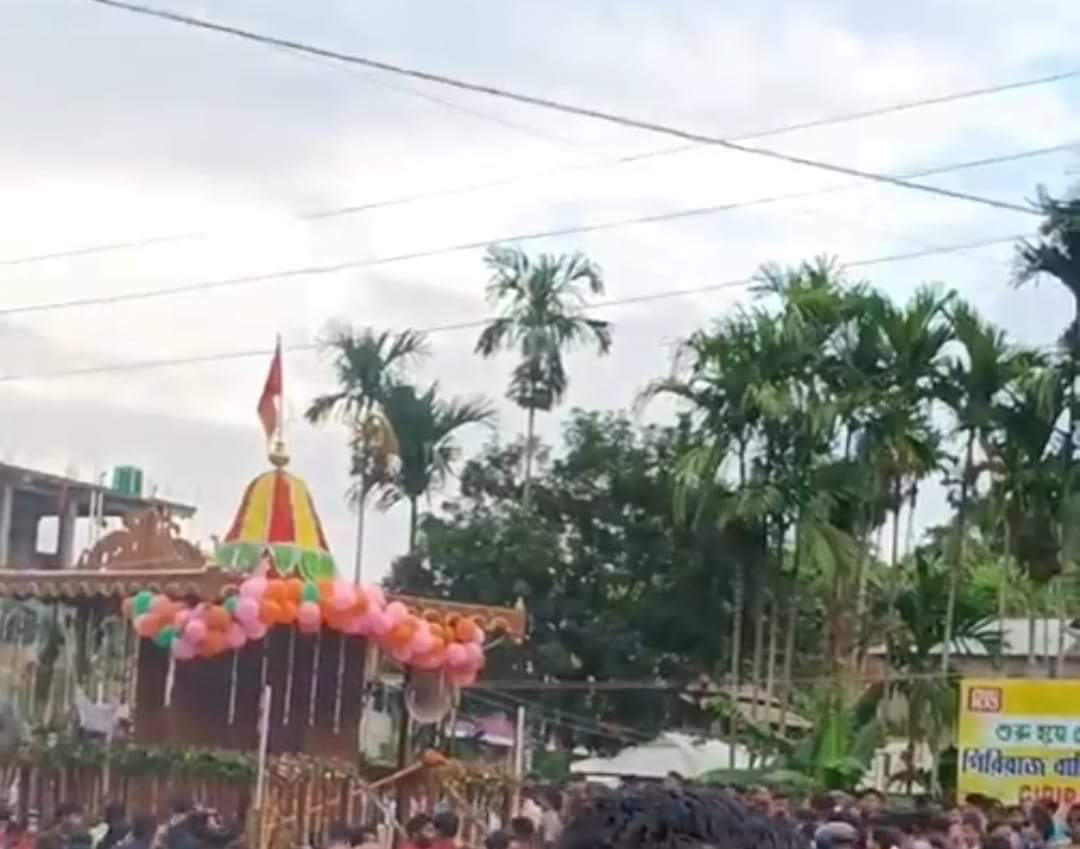
PTI: Seven people, including two children, died of electrocution and 16 others were injured as a Rath or ceremonial chariot of Lord Jagannath came in contact with a high-tension wire in Tripura's Unakoti district on Wednesday, police said.

The incident happened around 4.30 pm in Uttar Pabiacherra in Kumarghat during the 'Ulta Rath Yatra' or return car festival organised by ISKCON, they said.

During this festival, the sibling deities -- Lord Balabhadra, Devi Subhdara and Lord Jagannath -- return to their abode in a chariot, a week after Rath Yatra.

Thousands of people were pulling the chariot, made of iron and heavily decorated, when it came in contact with a 133 kv overhead cable. Parts of the Rath immediately caught fire and people fell on the road with their bodies on flame, police said.

Fire Services reached the spot, and brought the situation under control, they said.

Six people died on the spot while one person died while being taken to the GB Pant Hospital in Agartala, they said.

Among the deceased, there were two children and three women, police said.

The injured persons were initially taken to the Kailashahar and Kumarghat hospitals in the district, and later some of them were sent to the GB Pant Hospital in Agartala as their conditions were critical, they said.

Prime Minister Narendra Modi said the incident was saddening.

"The mishap during the Ulta Rath Yatra at Kumarghat is saddening. Condolences to those who have lost their loved ones in this mishap. May the injured recover soon. The local administration is providing all possible assistance to those affected," the Prime Minister's Office (PMO) tweeted, quoting him.

He announced Rs 2 lakh ex-gratia from the Prime Minister's National Relief Fund (PMNRF) to the next of kin of each deceased, and Rs 50,000 for those injured in the mishap.

Chief Minister Manik Saha went to Kumarghat in the night by train, and met the injured persons.

Accompanied by state minister Tinku Roy, Saha visited the Kumarghat hospital and enquired about the well-being of the people, assuring them of all possible help.

Addressing a press conference late in the night, he announced that the government has ordered a district magistrate-level inquiry into the incident.

"I have visited the spot, and met the injured persons. The government will bear the expenses of their treatment," he said.

"The state government will give Rs 4 lakh to the next of kin of the deceased, and Rs 2.5 lakh to persons who suffered more than 60 percent burn injuries. People whose injuries are not that severe will be given Rs 74,000. This will be in addition to the ex-gratia announced by the prime minister," he added. State Power Minister Ratan Lal Nath said he has directed the Tripura State Electricity Corporation Ltd to probe the incident, and submit a report immediately.

Leader of Opposition Animesh Debbarma of the Tipra Motha demanded strong action against those behind the lapses, which led to the accident.

"It appears that the incident took place due to lack of alertness of the local administration," he alleged.

The state Congress and CPI(M) also extended condolences to the families of the deceased persons.

The state BJP cancelled all its programmes on Thursday, and said that its president Rajib Bhattacharjee will visit the area.


Wednesday, 17 May 2023

Kharagpur house of BJP's Dilip Ghosh vandalised by Kurmi outfit


Kharagpur: BJP national vice-president Dilip Ghosh's house in West Bengal's Kharagpur was vandalised on Wednesday allegedly by members of a Kurmi outfit, which has been demanding his apology claiming that he insulted the community.

With flags and placards, members of the Adivasi Kurmi Samaj Purulia Zilla Committee allegedly broke window panes and doors of Ghosh's rented accommodation in the city.

A police team reached the spot a while later, and removed the protesters, officials said.

However, it could not be immediately known if any arrest was made in connection with the incident.

Ghosh, who is in New Delhi at present, alleged that the TMC was behind the vandalism.

"I have supported the Kurmis in their demand for ST status. The TMC is trying to divert attention from the issue by misinterpreting my statements. TMC activists, disguised as Kurmis, attacked my residence," he alleged.

Ghosh made certain unwarranted remarks about the Kurmis when he got stuck due to a demonstration by the community over their demand for ST status. It happened a few days back when the Medinipur MP was on the way to neighbouring Jhargram district, the protesters alleged.

The TMC rejected Ghosh's allegation that its members were involved in the vandalism.

"These are baseless allegations. He should apologise for hurting the sentiments of the Kurmi community," TMC's Paschim Medinipur district leader Ajit Maity said. [PTI]


Wednesday, 10 May 2023

India needs strong Opposition; Mamata Banerjee should be Prime Minister: Subramanian Swamy

India needs strong Opposition; Mamata Banerjee should be Prime Minister: Subramanian Swamy

Former Union minister also expresses many hardline Hindutva views and bitterly criticises Congress leaders Rahul Gandhi and Sonia Gandhi

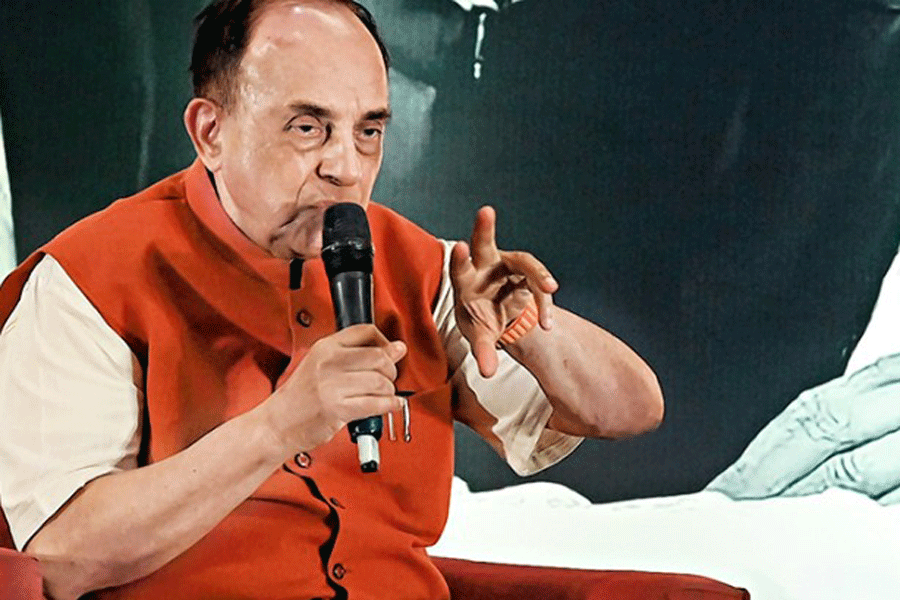
Subramanian Swamy at the interaction in Calcutta on Tuesday.

Subramanian Swamy at the interaction in Calcutta on Tuesday.Pradip Sanyal

Writes :Meghdeep Bhattacharyya

BJP leader Subramanian Swamy, known for being an unsparing critic of Narendra Modi, said on Tuesday that he believes Mamata Banerjee ought to be Prime Minister, underscoring the need for a strong Opposition, and lashing out at the “creeping fascism” where the media is browbeaten.

The 83-year-old politician-economist who makes no bones about being a hardliner Hindu nationalist, was in the city for a freewheeling chat in an event organised by Ficci FLO, Calcutta.


The event, “Dr. Subramanian Swamy Unplugged”, saw him in conversation with author and journalist Kaveree Bamzai. “I see women protesting against a woman,” laughed a somewhat surprised Swamy.

Despite disapproval from many in the audience, Swamy persisted.

“Gutsy woman… look at how she fought the communists.... Nobody had the guts to stand up to the communists, she did and knocked them out,” he said.

“I am in touch (with Mamata).... I met her about 10 days ago, but nobody knows about it. The conversation was about what 2024 should be, how the economy should be,” he said.

He stressed the importance of the nation having a genuine Opposition — on the sidelines, he said he was sure theBJP would retain power in 2024, but not so sure about Modi remaining Prime Minister and said a lot would be determined by the outcome of Assembly polls in a number of states.

“I do think the country needs a genuine Opposition, which cannot be blackmailed by people in power. She (Mamata) is impossible to blackmail...,” said Swamy.

“But I know a lot of politicians today will not go beyond a point in dealing with the present government, because they are afraid the ED will turn up, the CBI will turn up....,” he said.

He rued the state of media in Modi’s so-called NewIndia.

“Today, the status of our media is pathetic. They are told by one junior joint-secretary of the PMO (Prime Minister’s Office) everyday, why did you publish this, why did you show that… (they threaten to) cut off all the government advertisements. This is what is called creeping fascism,” said Swamy.

During the course of the chat, Swamy also expressed many hardline Hindutva views and bitterly criticised Congress leaders Rahul Gandhi and Sonia Gandhi.

Asked to comment on the Narendra Modi government’s role in handling the recent Adani debacle, he said: “There is only way proper to deal with the Adani issue, and that is by Prime Minister Modi resigning his post.”

“He (Gautam Adani) could not have done anything without Modi’s clearance...,” said Swamy.

Critical of Modi for allegedly hogging credit for the Ram temple in Ayodhya, Swamy said: “He did nothing and took all the credit.”

“This craze for position is not Hindu…. I nowadays compare Modi to Ravan,” he added.


source : Telegraph

Tuesday, 9 May 2023

North Bengal University, Indian army team up for new research centre to help defence forces


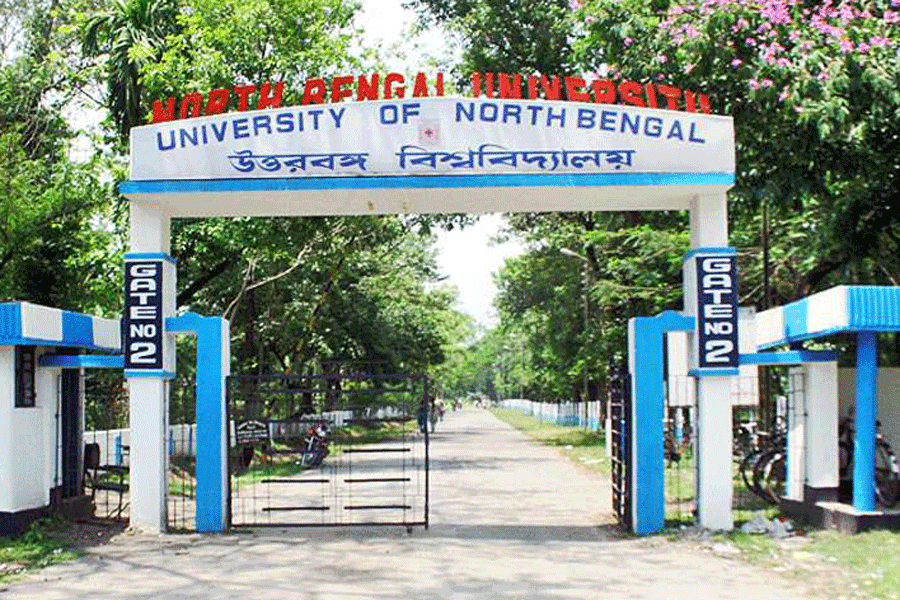
North Bengal University.

North Bengal University.File photo

Writes : Binita Paul

The North Bengal University here has teamed up with the Indian army to set up a new research centre to help the defence forces.

On Monday, varsity authorities held a meeting with officers of Trishakti Corps, the army headquarters in Sukna on the outskirts of Siliguri, which looks after the north Bengal region and Sikkim that sits on the India-China border, for a “collaborative approach” for the research centre.

The Siliguri corridor, also known as the chicken’s neck, is the slimmest area of the Indian subcontinent. Here, the width of the country is around 24km, perched between Nepal in the north and Bangladesh in the south, and China and Bhutan nearby.

“This area connects to the entire northeast India and sensitive areas like Doklam and Arunachal Pradesh.... A research centre at the oldest varsity of this region (the NBU was set up in 1962), with a focus on various aspects of the region like demography, political history, geography, flora and fauna can surely help the defence forces with a better understanding of this region,” said a retired army officer.

For the new centre, the varsity has deputed Soumitra Dey, a professor of political science department, as the founder and director of the Centre.Three other faculty members from the Centre for Himalayan Studies, history and political science have been included in the team, said sources.

“It will be a collaborative approach. The varsity will use its resource persons and experts to disseminate more comprehensive information about this region, ranging from the local economy to local cultural practices. The research will be vital, considering the geo-political scenario of north Bengal and Sikkim and international relations with neighbouring countries,” said a senior NBU faculty member.

In recent times, the Indian army has started various activities to hone the skills of its personnel, keeping in mind China’s aggressive overtures.

Last May, the army signed an MoU with Sikkim University for a six-week Tibetology cadre course for an insight into the history, religion, language, culture, politics, demography and geography of Tibet and China. This April, an MoU was signed between Tezpur University of Assam and the army to teach Mandarin to the defence personnel.


source : Telegraph

Friday, 24 February 2023

Foresters step in for student safety from wild elephants in north Bengal

Foresters step in for student safety from wild elephants in north Bengal

Writes : Bireswar Banerjee

The forest department on Friday introduced a slew of measures for the protection of Madhyamik examinees from wild elephants in north Bengal and they included the arrangement of transportation for students, deployment of tactical vehicles to ward off animals and intensified patrolling. 

The measures which were launched near elephant habitats in the districts of Darjeeling, Jalpaiguri and Alipurduar would be made available during higher secondary and madarsa examinations also, said the forest department. 

The initiatives were taken a day after Arjun Das, who was on the way to a Madhyamik centre, had been trampled to death by an elephant in the Jalpaiguri district. The 15-year-old boy was pillion-riding with his father Bishnupada when the elephant attacked them. The father-son duo were taking a shortcut road through the Baikunthapur forest. Bishnupada managed to escape with minor injuries.

After the incident, chief minister Mamata Banerjee expressed her concern and instructed the forest department to take appropriate steps for the safe journey of the Class X examinees living near elephant habitats.

Accordingly, Vivek Kumar, additional chief secretary of the department, issued an order, and foresters across these three districts took the task to implement it. 

“A list of around 300 localities and routes where there is a chance of elephant attacks was prepared. A plan was drawn to confirm that around 2,000 examinees, who live in such areas, are provided with transport and escort. The service started today. We will provide similar services during higher secondary and madrasah examinations,” said Ujjwal Ghosh, the additional principal chief conservator of forests (north).

The administration and the police are helping them in the exercise, he said.      

“We have also intensified vigil along the elephant habitats and monitoring the movement of elephant herds,” said the senior forester.

In Jalpaiguri, sources said, foresters today provided transport to examinees living in 41 different locations which are close to elephant corridors and reserve forests.   

Today morning, a team of foresters also reached Maharajghat, Arjun’s village in Rajganj block of Jalpaiguri. There, they made public announcements, asking people to refrain from using forest roads.

“We provided three SUVs and the district administration has provided two buses to transport students to their respective examination centres. Two camps have been set up at Maharajghat and Millanpally (a neighbouring locality) and 16 guards have been posted in each camp. An ‘Airavat’ has been placed in Takimari (an adjoining area) to drive away elephant herds,” said a forest officer.

Like Jalpaiguri, foresters also made transport arrangements for examinees, who live near elephant habitats of Siliguri sub-division and Alipurduar district.  

The Bagdoga forest range of the Kurseong forest division arranged vehicles. 

In Alipurduar, examinees were seen traveling in vehicles from villages located near the Buxa Tiger Reserve and Jaldapara National Park.

“We engaged 90 employees and 22 vehicles. Twenty-nine 29 shortcut routes through the forests have been blocked. Today, we carried 710 students from 43 villages,” said a forester in Alipurduar.

Later in the day, Khageswar Roy, the local MLA of Rajganj, reached Arjun’s house with Moumita Godara Basu, the DM of Jalpaiguri, Akhilesh Chaturvedi, the commissioner of Siliguri Metropolitan Police and some others.

They handed over a cheque for Rs five lakh to the boy’s father.

Source The Telegraph, Additional reporting by our Jalpaiguri and Alipurduar correspondents